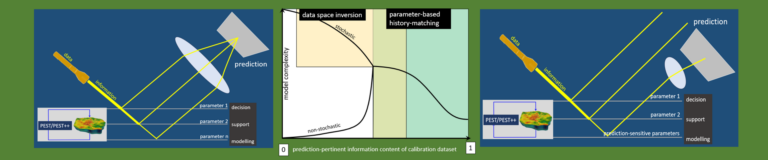
Decision-Support Modelling Appropriateness and the Journey of Information
This short monograph packs a lot of punch. It starts by solving an almost trivial, nonunique inverse problem. While simple, the problem is typical of
This short monograph packs a lot of punch. It starts by solving an almost trivial, nonunique inverse problem. While simple, the problem is typical of
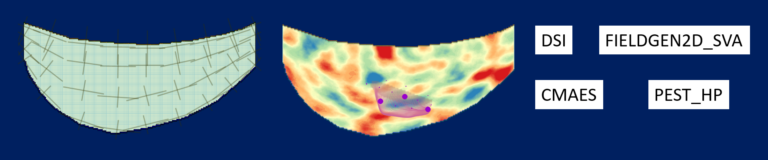
Optimization under uncertainty is notoriously numerically intensive. However its numerical burden can be reduced if data space inversion (DSI) is used to construct a surrogate

Ensemble space inversion (ENSI) enables efficient, regularisation-constrained calibration of complex, highly-parameterised models. This tutorial demonstrates how linear analysis can be undertaken in partnership with the

Ensemble space inversion (ENSI) is implemented through the PEST_HP suite (version 18). Using ENSI you can calibrate a complex model quickly. The calibration subspace is comprised

Building and history-matching a three-dimensional model is a difficult procedure. The third dimension increases parameter requirements, model run times, and model output uncertainty. Ideally, predictive

Description Where: EcoSciences Precinct, Dutton Park, Brisbane When: Monday 3rd June to Friday 7th June, 2024 Who should attend: Both new and experienced modellers will benefit from

This tutorial explores the use of “conceptual points” as a precursor to model parameterisation. Expected hydraulic properties are provided at these conceptual points. Just as

This tutorial explores construction of the interface between PEST/PEST++and a simple MODFLOW/MODPATH model, and how to then subject that model to history-matching and uncertainty analysis–including

View the webinar recording introducing the course here. This free guided self-study course and weekly Q & A sessions with the GMDSI team provided guidance and

What should decision-support groundwater modelling seek to accomplish? Should it try to build a digital replica of what happens underground? Obviously not, because this is